


A recent national study tracked how 200,000 ambulatory physicians spend their time inside the electronic health record. The headline number: about one hour per eight-hour clinic day on chart review. Across roughly twenty patients, that works out to three minutes of chart review per patient.
If you practice Functional Medicine, that number is not your number.
You already know this. Your panels run 60 to 100 markers, sometimes more. Your patients arrive with histories that span years, not visits. You read against optimal ranges, not just standard reference ranges. The work you do at your desk before a follow-up appointment looks nothing like what that benchmark measured.
But the gap between the conventional benchmark and your reality is not just about volume. It is qualitatively different work. And the cost of that difference shows up somewhere most practitioners do not name out loud: cognitive bandwidth.
Consider a new patient.
Forty-five years old, presenting with fatigue, weight gain, and brain fog. Her panel comes back with:
TSH at 2.8
Free T3 low-normal
Free T4 mid-range
Reverse T3 elevated
Anti-TPO at 35
Ferritin at 22
Vitamin D at 28
Fasting insulin at 11
Hs-CRP at 2.4.
A conventional read marks this panel as mostly normal. TSH is in range. Free T4 is in range. Anti-TPO is below the standard cutoff. The visit moves on.
A Functional Medicine read does something different.
The same numbers tell a story about subclinical thyroid dysfunction with poor T4-to-T3 conversion, possible early autoimmune thyroid involvement, iron insufficiency contributing to that conversion impairment, metabolic dysregulation suggested by the insulin-glucose relationship, and low-grade systemic inflammation that ties the picture together.
Same labs. Different question. Different work.
The Functional Medicine read is not just slower. It is structurally different. It requires holding multiple systems in mind at once, recognizing patterns across markers that a conventional read treats as unrelated, calculating ratios, and integrating the lab picture with everything else you know about the patient.
This is where the real cost lives.
Most conversations about practitioner burden focus on hours. Time spent on documentation, time on the inbox, time after clinic. Those are real. But for Functional Medicine specifically, the dominant cost is not the clock. It is the cognitive load required to do the interpretive work well.
Cognitive load theory describes three layers of mental demand: the inherent complexity of the task, the noise around it, and the synthesis effort required to make sense of it. Functional Medicine lab review is high on all three. The task itself is complex because biology is interconnected. The noise is high because lab platforms, units, and reference ranges vary. The synthesis effort is high because meaning emerges from combinations, trends, and relationships, not from any single flagged result.
The practical consequence is that the burden does not scale linearly with biomarker count. Doubling the number of markers more than doubles the cognitive demand, because every new marker creates new potential relationships to evaluate. A 100-biomarker panel is not five times harder than a 20-biomarker panel. It feels like ten.
This is why a Friday afternoon panel is harder to read than a Monday morning one, even when the patient is no more complex. You are not running out of time. You are running out of cognitive reserves.
The cognitive load shows up in three specific places:
The first is the depth versus schedule tradeoff. Every Functional Medicine practitioner makes this call almost weekly. Go deep on this panel and run late, or stay on schedule and accept that you will miss something. There is no clean answer. You make the call based on how mentally fresh you are, which is not a clinical variable you should be optimizing against.
The second is the patient conversation itself. The interpretation is not the goal. The conversation is. But if you spend the morning depleting your cognitive reserves on lab synthesis, the patient at 3 PM gets a different version of you than the patient at 9 AM. That is not a time problem. It is a bandwidth problem.
The third is consistency across practitioners. In a multi-practitioner clinic, two clinicians reading the same panel will reach different conclusions, weighted differently, with different action items. That variability is not a quality problem with your team. It is what happens when complex synthesis depends on individual cognitive state. A clinic cannot scale a standard of care that lives only in the heads of its most senior practitioners.
The fix is not to read faster. It is to move the synthesis out of working memory and into a system that does it the same way every time.
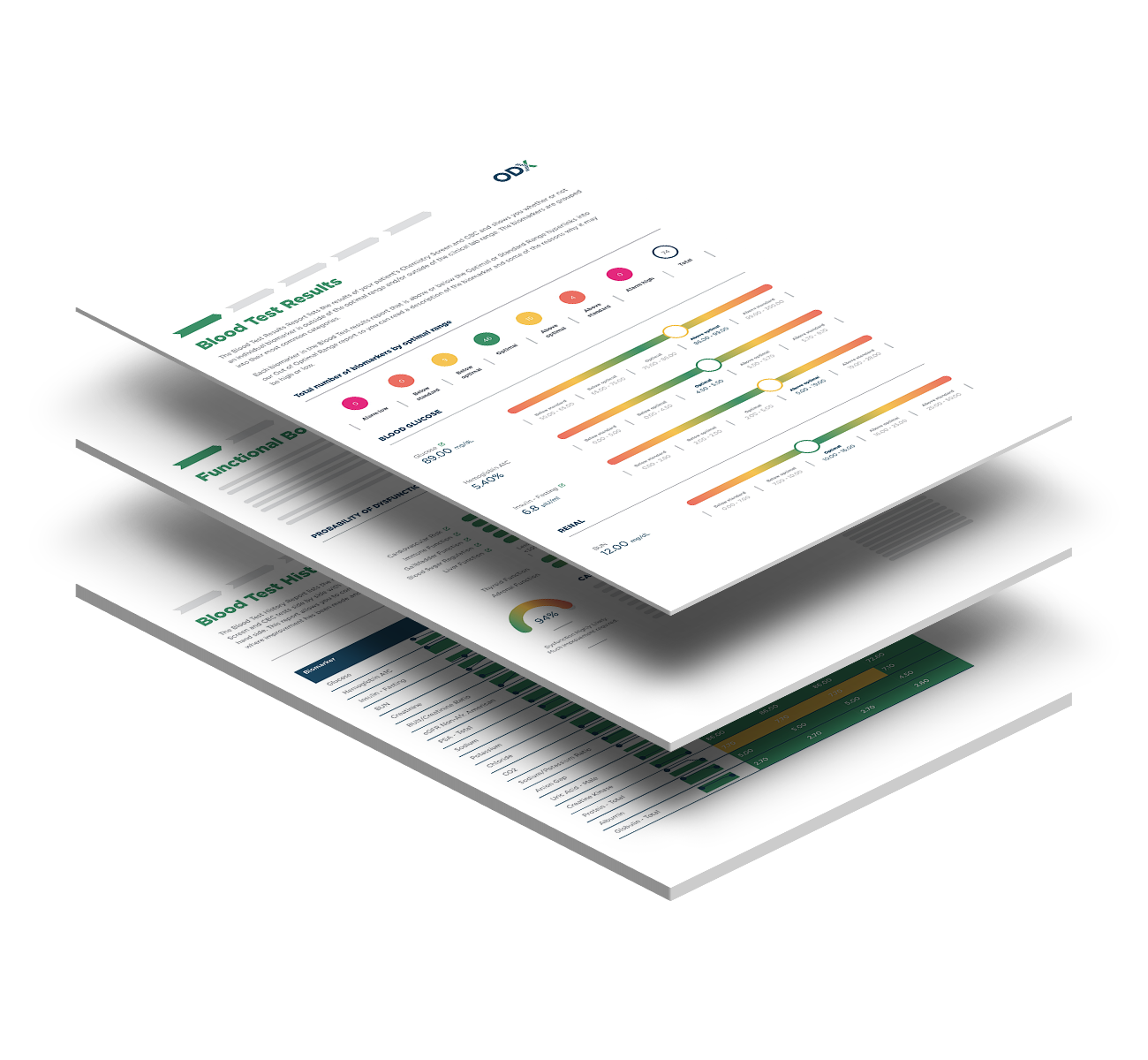
That is what Optimal DX does. Pattern recognition across systems, ratio calculation, optimal range comparison, and dysfunction likelihood scoring all run before you open the chart. The output is a Functional Health Report that has done the multi-variable work for you.
What you do then is different. You verify rather than synthesize. You make decisions rather than build them from raw data. You walk into the patient room with the picture already assembled, which means your cognitive reserves are still intact for the conversation that actually drives the outcome.
The time savings are real. Most practitioners report 30 to 45 minutes back per new patient workup. But the more important shift is the one that does not show up on a stopwatch. You finish the day with cognitive bandwidth left over. The patient at 3 PM gets the same quality of thinking as the patient at 9 AM. New practitioners in your clinic can interpret panels at the same standard as senior clinicians on day one, because the standard lives in the system, not in their working memory.
Functional Medicine practitioners did not enter this work to spend evenings interpreting biomarkers. They entered it because the conventional model was missing the patient. The cognitive load of doing Functional Medicine well is the price of working at that depth, and most practitioners pay it without naming it.
Naming it is the first step. The second is recognizing that the load is movable. Synthesis can be externalized. Pattern recognition can be systematized. Once that work is off your plate, what remains is the part of practice that actually requires you: the clinical judgment, the patient relationship, the treatment decisions.
Optimal DX is not built to save you a few minutes. It is built so that the cognitive work of Functional Medicine no longer has to live inside your head, and so that the patient at the end of your day gets the same practitioner the patient at the start did.
Watch the demo at optimaldx.com/demo. Then test it on a panel you have already interpreted yourself. Compare what we flag to what you found. That is the most honest test of the difference.
Holmgren AJ, Sinsky CA, Rotenstein L, Apathy NC. National Comparison of Ambulatory Physician Electronic Health Record Use Across Specialties. Journal of General Internal Medicine. 2024;39(14):2868-2870. doi:10.1007/s11606-024-08930-4


