

A founder's note from Dicken Weatherby, ND
In 2016, I sat down with one of the early pioneers of the functional blood chemistry movement. A figure from the 80s and 90s, someone who had helped shape the field I'd built my career on. By then, I'd had Optimal DX in the market for a few years, and I wanted his read on what we were doing.
He was impressed by three things, he told me.
First, I had cracked the nut on turning Functional Blood Chemistry Analysis (FBCA) into a computerized reporting tool that practitioners actually used.
Second, I had found a way to make it a sustainable business.
And third, that I was still in business at all.
That last one stuck with me. He said many people had tried to do what I was doing. Few of them had survived. There were a lot of gravestones along that road.
I've thought about that conversation many times in the ten years since. He was right, and I've watched it happen in real time. People come into this space with big budgets, big announcements, and big promises, and most of them are gone within a few years. Some failed because the technology wasn't ready, others because they were chasing a market that didn't exist yet, and still others because they tried to do too much, too fast, and ran out of road before they could finish what they started.
I'm still here because I'm a tortoise.
I trained as a Naturopathic Doctor at the National College of Naturopathic Medicine in Portland, starting in 1994. A year in, I was introduced to FBCA, and I knew almost immediately that this was the work I wanted to do. It offered something I hadn't seen anywhere else in my training: a way to identify dysfunction in the body long before it became disease.
I spent the next several years practicing it, teaching it, and writing about it. In 2002, I published Blood Chemistry and CBC Analysis: Clinical Laboratory Testing from a Functional Perspective because the reference material I needed didn't exist, and I got tired of waiting for someone else to write it. I taught seminars across the US, Canada, and Europe, built an online certification program, and for about sixteen years, the work was entirely analog: books, courses, consultations, handouts.
By 2011, I'd reached a limit. The interpretive work I'd been teaching practitioners to do by hand was too valuable to leave on paper, and too time-consuming for most practices to actually use. I'd been thinking about software for a while, but I wasn't going to move until three things were true.
The technology had to be right. Software-as-a-service was finally a real option, which meant I could build something that updated itself instead of shipping CDs to practitioners.
The audience had to be ready. By then, I had enough of a following from the books, the courses, and the seminars to support both the build and the first round of subscribers.
And the team had to be in place. I had the knowledge. I needed someone who could turn that into code. Shane Redlick joined me as the technical half of the partnership. He's still with me today as CTO and COO, and the company doesn't function without him.
When all three were true, I moved.
I founded Blood Chem Software, which became Optimal DX, with one goal: to take what I knew about Functional Blood Chemistry and turn it into a tool practitioners could actually use in a working practice.
That was 14 years ago.
I am a technophile and an early adopter of technology. I was the first student at NCNM to get a laptop back in 1995. But by temperament and by hard-won experience, I'm also a methodical/pragmatic technologist! I employ technology when it serves the cause, not when the market tells me I'm supposed to. I let other people go first and watch what works and what breaks. When I move, I move in a direction I can sustain.
It's how I've kept the company alive while watching others fold. The Functional Medicine and blood chemistry space is full of people who came in loud and left quietly. The work I care about, the work of helping practitioners help their patients, rewards finishing what you start.
So when something new arrives, I'll eagerly adopt it for my own use, but my first questions for my company are "Is this ready?" and "Is this right?"
For most of the last few years, when people asked me about AI, my answer was the same. Not yet. The technology was interesting, but it wasn't ready for the kind of work we do. I wasn't going to bolt AI onto Optimal DX because every other software company was doing it. Let the others go first and learn the hard lessons. I'd watch.
That position has changed. I want to tell you why, and I want to tell you what we will and will not do with AI at Optimal DX, before you see any of it in the product.
At Optimal DX, we view AI as a very smart research assistant. That's the entire frame. It is a tool that can pull information together faster than any human can, spot patterns, and do in seconds what used to take an hour. That is genuinely useful, and I'm not interested in pretending otherwise.
AI is a research assistant in our product. It will never be a clinician.
I believe wholeheartedly in the practitioner-patient relationship. That relationship is the irreducible core of Functional Medicine, and it's what makes the work matter. Everything we build at Optimal DX has to protect it. If a tool we build erodes that relationship, even slightly, it's the wrong tool, no matter how clever it is.
Functional Medicine is too nuanced for AI to practice unsupervised. It's also too time-consuming for practitioners to scale without help. Those two truths sit side by side, and they define the space where AI belongs in our work. AI handles the parts that drain practitioners of time, while practitioners handle the parts that require judgment, experience, and the human relationship that no software can replicate.
That's where the line sits, and we're going to stay on the right side of it.
It matters as much to say what we will not do as what we will. So let me be specific.
We will not have AI diagnose patients. AI can help a practitioner see patterns they might miss, but diagnosis stays with the practitioner.
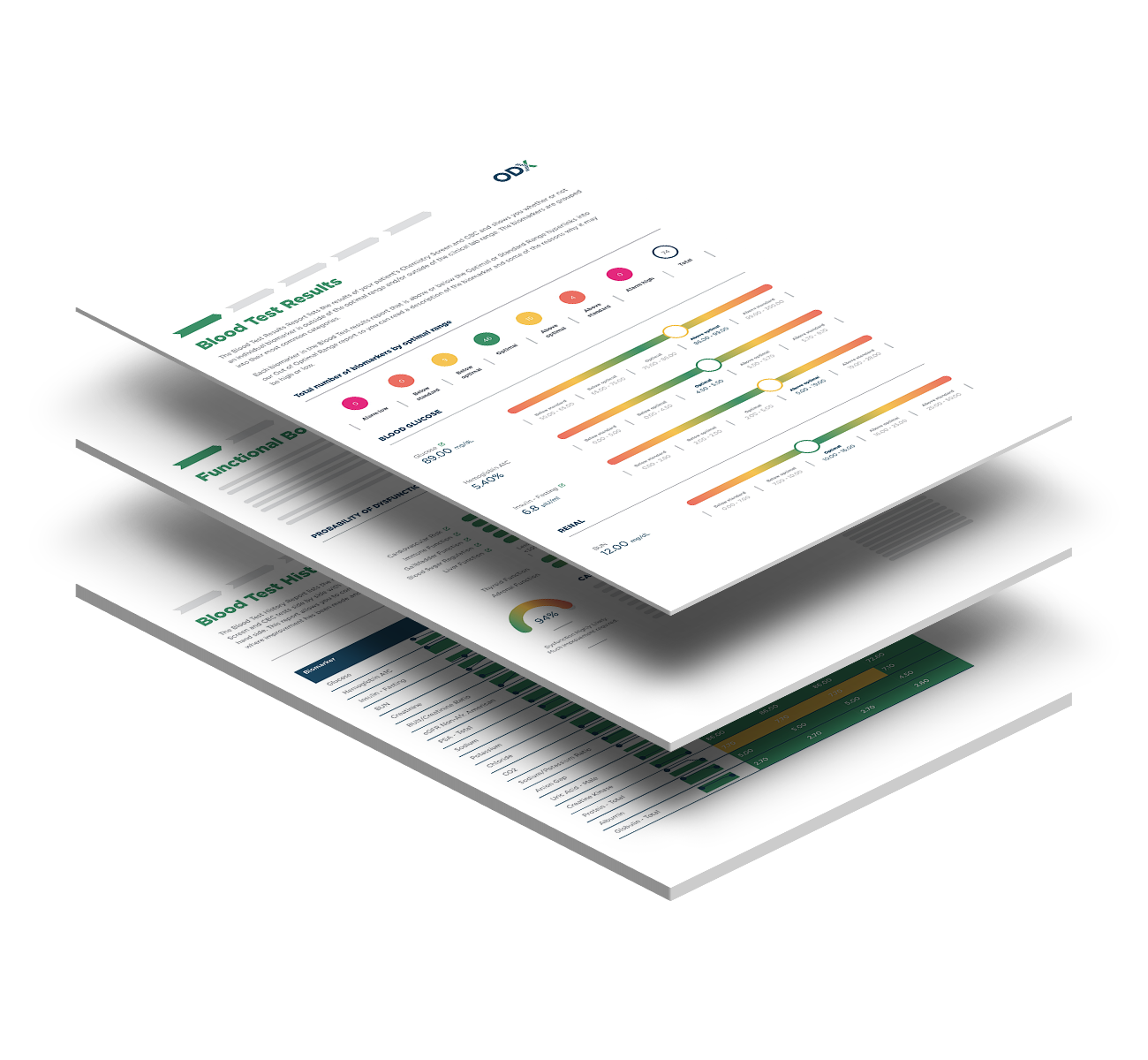
We will not deliver AI-generated lab interpretations or assessments to patients without practitioner review. The Functional Health Report (FHR) is the foundation of what we do. We plan to use AI to help see patterns within the patterns the FHR uncovers, with a practitioner always in the loop. Patients receive nothing from us that hasn't passed through a practitioner first.
We will not train AI on un-anonymized patient data. We are fully committed to protecting patient information. This line is not negotiable. If our position on this ever changes, you'll hear it from me directly, with the reasoning. It is not going to change.
These are commitments. We're not going to relax them once the market gets used to AI. They reflect how I think this work should be done and what I believe practitioners deserve from the software they trust with their practice.
Three things had to be true before I was willing to move.
First, we needed a team that understood the stakes and could build with the kind of restraint this work requires. We have built that team.
Second, we needed a research foundation strong enough to anchor AI's output. Our research team recently completed a multi-year project building out a Functional Medicine and FBCA knowledge base. The AI we use draws on a body of work we've vetted, structured, and trust, which is a meaningfully different starting point than the open internet. That foundation is what makes responsible AI possible in our context. Without it, I wouldn't move.
Third, the technology had to actually be good enough. Earlier generations of these tools could not have done the work we now need them to do. The current generation can. We've tested it hard enough to know.
All three are true. So we're moving.
You're going to see AI show up in Optimal DX in the coming weeks and months. The first place is small and specific, and it's called Recommended Actions. I'll write more about how it works in a follow-up post. There will be more after that.
Every piece of it will follow the same principles. AI drafts and practitioners decide. Patients receive nothing without a practitioner in the loop. Patient data stays protected, and the practitioner-patient relationship stays at the center.
I'm telling you this now, before you see any of it, because you deserve to know how we're thinking before you have to react to what we're building. If you've been with us for a while and you're skeptical, I understand. I was skeptical too, and I'm the one building it. If you're newer to Optimal DX and you've been wondering when we'd get here, we're here, and we're doing it on purpose.
I'm in this for the long haul. I always have been, and the pace and the principles haven't changed. What's changed is that one of the tools in front of me finally got good enough to use, and I'm going to use it the way I'd want someone to use it on my behalf: slowly and carefully, with the practitioner in the room where the decisions get made.
Dicken Weatherby, ND
Founder, Optimal DX