

Discover the optimal timing for drawing female hormone labs throughout the menstrual cycle (MC) to assess fertility, irregular periods, and hormonal changes.
The ideal day or time to draw female hormone labs depends on the target hormone and the clinical objectives, e.g., assessing fertility, irregular periods, abnormal bleeding, or perimenopausal changes.
Some hormones are best evaluated within a few days of menses onset, while others may be assessed later in the cycle. However, if bleeding is abnormal, labs can be drawn on any day (Testing.com, ClevelandClinic.org).
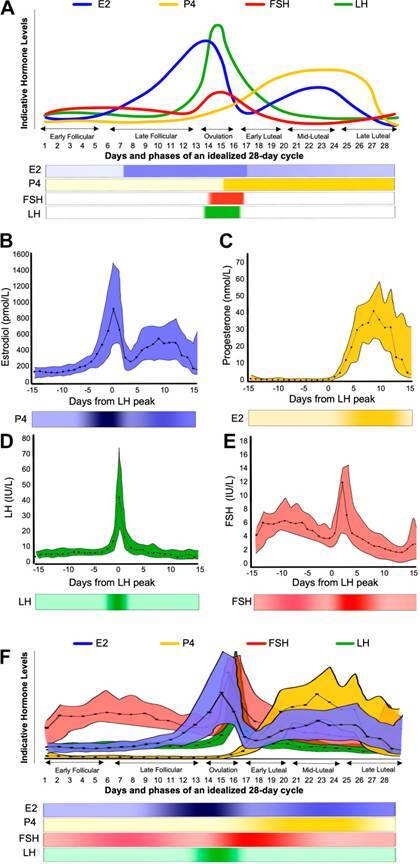
A: hormonal fluctuations across an idealized (textbook) 28-day MC, with ovulation occurring on day 14. Hormone values in daily serum samples across the MC for naturally cycling women, adapted from Stricker et al. (6). Estradiol (B); progesterone (C); luteinizing hormone (D); follicle-stimulating hormone (E); and estradiol, progesterone, luteinizing hormone, and follicle-stimulating hormone concentrations overlapped (F). Solid lines represent median values; the colored area highlights the 95% confidence interval range. All figures are accompanied by a visual color gradient depicting changes in the respective hormone concentrations across the MC. E2, estradiol; FSH, follicle-stimulating hormone; LH, luteinizing hormone; MC, menstrual cycle; P4, progesterone. (6–8). (D’Souza 2023 Creative Commons Attribution CC-BY 4.0)
Estradiol – Standard Chemiluminescent Immunoassay
|
Phase |
Approximate Estradiol Range |
|
Follicular phase (days 1 to 13) |
30 to 144 pg/mL |
|
Mid-cycle peak (around day 14) |
64 to 357 pg/mL |
|
Luteal phase (days 15 to 28) |
56 to 214 pg/mL |
|
Postmenopausal women |
0 to 30 pg/mL |
Ranges are approximate and vary by lab and assay. Use the reference interval on your lab report.
Estradiol - Ultrasensitive
|
Population |
Estradiol Range |
|
Women, follicular phase |
39 to 375 pg/mL |
|
Women, luteal phase |
48 to 440 pg/mL |
|
Postmenopausal women |
10 pg/mL or less |
The ranges are approximate and vary by lab and method. Your lab report will include the specific reference range used for your sample.
|
Phase |
Approximate FSH Range |
|
Female, follicular phase (days 1 to 13) |
2.5 to 10.2 mIU/mL |
|
Female, mid-cycle peak |
3.1 to 17.7 mIU/mL |
|
Female, luteal phase |
1.5 to 9.1 mIU/mL |
|
Female, postmenopausal |
23.0 to 116.3 mIU/mL |
The approximate reference ranges below come from Quest Diagnostics data. Ranges vary by lab and assay.
|
Phase |
Approximate LH Range |
|
Follicular phase |
1.9 to 12.5 IU/L |
|
Ovulation peak |
8.7 to 76.3 IU/L |
|
Luteal phase |
0.5 to 16.9 IU/L |
Ranges are approximate and vary by lab. Talk to your provider about what your number means.
|
Phase / Status |
Approximate Progesterone Level |
|
Follicular phase (before ovulation) |
Less than 1 ng/mL |
|
Mid-luteal phase (around day 21) |
5 to 20 ng/mL (varies widely) |
|
Ovulation confirmed (common cutoff) |
Greater than 3 ng/mL |
|
First trimester |
4.1 to 34.0 ng/mL |
|
Second trimester |
24.0 to 76.0 ng/mL |
|
Third trimester |
52.0 to 302.0 ng/mL |
|
Postmenopausal |
Less than 1 ng/mL |
Ranges are approximate and vary by lab. Always read your result against the reference range printed on your report.
Ahmad, Naseer et al. “The optimal timing of blood collection during the menstrual cycle for the assessment of endogenous sex hormones: can interindividual differences in levels over the whole cycle be assessed on a single day?.” Cancer epidemiology, biomarkers & prevention : a publication of the American Association for Cancer Research, cosponsored by the American Society of Preventive Oncology vol. 11,1 (2002): 147-51.
Cleveland Clinic. Menstrual Cycle https://my.clevelandclinic.org/health/articles/10132-menstrual-cycle
D'Souza, Alysha C et al. “Menstrual cycle hormones and oral contraceptives: a multimethod systems physiology-based review of their impact on key aspects of female physiology.” Journal of applied physiology (Bethesda, Md. : 1985) vol. 135,6 (2023): 1284-1299. doi:10.1152/japplphysiol.00346.2023 Creative Commons Attribution CC-BY 4.0
Testing.com
https://www.testing.com/tests/female-hormone-tests/
https://www.testing.com/tests/comprehensive-female-hormone-panel/
https://www.testing.com/tests/fsh-lh-test/