


In recent years, there have been significant advancements in noninvasive methods for blood glucose monitoring. These methods focus on using alternative biofluids like tears, saliva, urine, and sweat instead of blood. Among these alternatives, sweat is especially promising for noninvasive, continuous glucose monitoring, as it can be easily collected from various body sites and reflects the body's physical condition rapidly.
Sweat is constantly secreted by the body during sedentary or routine activities, such as sitting or standing. This natural perspiration occurs at a much lower rate than during exercise and helps to fine-tune the body's temperature. As a result, sweat provides a convenient and nonintrusive way to monitor underlying health conditions such as blood glucose levels.
Advancements in microelectronics and electrochemical sensing platforms have led to the development of personal devices that utilize sweat to monitor physiological and metabolic information.
While most sweat glucose sensors have focused on exercise-induced sweating, natural sweating is an attractive alternative. It allows for monitoring during routine and sedentary activities without affecting personal lifestyle and maintains the correlation between blood and sweat glucose levels.
Researchers have developed a noninvasive sweat glucose sensor using convenient hydrogel patches that can rapidly sample natural perspiration without requiring external stimuli to induce sweating. The wearable hydrogel patch absorbs sweat from the hand, serves as a medium for electrochemical sensing, and is used for sweat glucose measurements.
The sweat glucose sensor was tested on human subjects consuming food and beverages, demonstrating its functionality through long-term measurements of sweat glucose. By allowing the analysis of sweat glucose during routine and sedentary activities, this sensor holds significant potential for clinical-grade glucose management.
In summary, noninvasive methods for blood glucose monitoring have made significant strides by focusing on alternative biofluids, particularly sweat. Sweat offers a promising means for continuous, noninvasive glucose monitoring during sedentary activities. The development of a wearable hydrogel patch and advanced sensing platforms has expanded the potential of noninvasive glucose monitoring, making it a promising option for next-generation sensing systems.
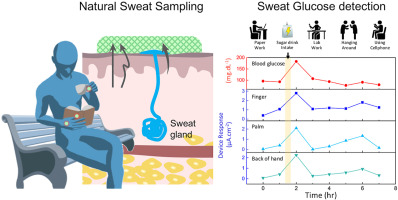
Lin, Pei-Heng et al. “Wearable hydrogel patch with noninvasive, electrochemical glucose sensor for natural sweat detection.” Talanta vol. 241 (2022): 123187. doi:10.1016/j.talanta.2021.123187 Under a Creative Commons license
CLICK HERE to read more about nutrition intervention for blood glucose dysregulation.